Paint Ideas For Bedrooms With Slanted Ceilings: Transform Your Space
Got a bedroom with slanted ceilings? You know the drill. They can feel like a design challenge, often making a room feel smaller, darker, or just… awkward. But what if I told you that those angles aren’t a problem to hide, but an incredible opportunity to create a truly unique and captivating space? It’s all about strategic paint choices.
As an interior design expert, I’ve seen slanted ceilings transformed from frustrating architectural quirks into stunning focal points. The right paint strategy can manipulate light, enhance dimension, and completely change the mood of your bedroom. Forget trying to pretend they’re not there; let’s embrace those slopes and turn them into your room’s most interesting feature.
This isn’t just about picking a pretty color. It’s about understanding how light hits those angles, how different hues play with perception, and how to use paint to solve common design dilemmas posed by pitched roofs. Ready to make your slanted ceiling bedroom a masterpiece?
Understanding Your Slanted Canvas: Why Angled Walls Are Unique
Before we dive into specific colors and techniques, it’s crucial to understand why slanted ceilings behave differently than traditional flat ones. This isn’t just aesthetics; it’s physics and psychology.
The Psychology of Slopes: How Angles Affect Perception
Our brains interpret angles differently. In a room with slanted ceilings, the eye naturally follows the slope, which can sometimes lead to a feeling of compression or imbalance. If not addressed correctly, this can make a room feel smaller than it actually is. However, these angles can also create a sense of intimacy and coziness, much like an attic retreat or a charming cottage room. Your paint choices can either exaggerate these feelings or cleverly counteract them, guiding the eye and redefining the perceived space.
Light & Shadow Play: Impact on Color Choice
Light is the ultimate designer, and slanted ceilings love to play with it. Unlike a flat ceiling that receives relatively uniform light, slanted surfaces catch light at different angles throughout the day. This means the same paint color can appear dramatically different on various parts of your slanted ceiling – brighter in some areas, darker and more shadowed in others.
This dynamic interaction is both a challenge and an opportunity. A color that looks perfect on a swatch might appear too dark or too stark once it’s stretched across multiple planes and bathed in varied light. Understanding this will help you choose colors that adapt beautifully to the changing light, rather than fighting against it.

Core Strategies: Painting Slanted Ceilings Like a Pro
There are several tried-and-true approaches to painting a bedroom with slanted ceilings, each with its own benefits. Let’s break down the most effective strategies.
Strategy 1: The Monochromatic Embrace (One Color for Walls & Slanted Ceiling)
This is arguably the most popular and often most effective strategy for slanted ceilings. By painting the walls and all angled ceiling planes the exact same color, you create a seamless, enveloping effect.
- When to use it: Ideal for smaller rooms you want to feel larger, or to create a cocoon-like, cozy atmosphere in any size room. It’s also fantastic for minimalist designs or when you want to minimize the visual breaks created by the angles.
- Pros: Creates a sense of expansive space by blurring the lines between walls and ceiling; makes the room feel taller and wider; highly cohesive and sophisticated; simplifies color selection.
- Cons: Can sometimes feel overwhelming if a dark color is used without sufficient natural light; lacks dramatic contrast if that’s what you’re after.
Think of it like wrapping your room in a single, comforting hue. Your eye flows uninterrupted, making the boundaries less defined and the room feel more expansive and unified. This works beautifully with light neutrals, soft pastels, or even rich, deep colors for a dramatic, intimate vibe.
Strategy 2: The Accent Angle (Highlighting a Slant)
Want to draw attention to a particular angle or create a focal point? Use an accent color! This strategy involves painting one or more slanted sections in a color that contrasts or complements your main wall color.
- When to use it: Perfect for creating a feature wall, defining a specific zone (like a reading nook or bed area), or adding a pop of personality. This works especially well if your slanted ceiling has a unique shape or architectural detail you want to emphasize.
- Pros: Adds depth and visual interest; creates a strong focal point; allows for creative expression; can make a room feel more intentional and designed.
- Cons: Can make the room feel busier or smaller if not chosen carefully; requires more precise painting and masking; can highlight imperfections if the lines aren’t crisp.
You could paint the entire peak a contrasting color, or perhaps just one long slanted wall that runs behind your bed. The key is to choose an accent color that works harmoniously with your main wall color and overall bedroom decor.
Strategy 3: The Traditional Divide (White or Light Ceiling)
Just because your ceiling is slanted doesn’t mean you can’t use a classic approach. Painting the angled ceiling in a traditional white or very light color, while keeping the vertical walls a different hue, is still a viable option.
- When to use it: When you want to brighten the room as much as possible, especially if natural light is limited. It creates a crisp, clean division and maintains a sense of height.
- Pros: Maximizes light reflection; feels fresh and airy; provides a clear visual separation between walls and ceiling; a timeless look.
- Cons: Can visually chop up the room, making it feel less cohesive; may emphasize the awkwardness of the angles rather than blending them; requires careful consideration of where to draw the paint line on the slope.
The trick here is deciding where the “ceiling” ends and the “wall” begins. Often, the best place to draw the line is at the lowest horizontal point of the slanted ceiling, or where the slope meets a vertical wall. Use painter’s tape to ensure a razor-sharp line.

Strategy 4: The Strategic Stripe or Pattern
For the truly adventurous, stripes, geometric patterns, or even a subtle mural on a slanted ceiling can be a showstopper. This transforms a challenging architectural element into an artistic statement.
- When to use it: In rooms where you want a playful, artistic, or highly personalized aesthetic. Great for kids’ rooms or a guest bedroom where you want to inject maximum personality.
- Pros: Highly unique and custom look; adds significant visual interest and dynamism; can cleverly redirect the eye.
- Cons: Labor-intensive and requires significant precision; can be overwhelming if not executed carefully; may limit future decor changes.
Consider wide, subtle stripes in two slightly different tones of the same color for a sophisticated look, or bold contrasting stripes for a dramatic impact. A soft, cloud-like mural can also be stunning in a bedroom with a high pitch.
| Strategy | Description | Best For | Pros | Cons | Visual Effect |
|---|---|---|---|---|---|
| Monochromatic Embrace | Walls and slanted ceiling painted the same color. | Small rooms, minimalist designs, creating coziness. | Expansive feel, cohesive, unified space, simple choice. | Can be overwhelming with dark colors if light is poor. | Blurs boundaries, makes room feel larger and integrated. |
| Accent Angle | One or more slanted sections painted a contrasting/complementary color. | Creating focal points, defining zones, adding personality. | Adds depth, visual interest, unique, customized look. | Can make room feel busier, requires precise painting. | Highlights architecture, draws eye to specific areas. |
| Traditional Divide | Slanted ceiling painted white/light, vertical walls a different color. | Maximizing brightness, classic aesthetic, airy feel. | Reflects light, fresh, clean, clear visual separation. | Can chop up space, emphasize awkward angles, critical line placement. | Defines wall/ceiling, can make room feel taller (sometimes at expense of cohesion). |
| Strategic Stripe/Pattern | Applying stripes, geometric patterns, or murals to slanted surfaces. | Playful, artistic rooms, personalized spaces, kids’ rooms. | Highly unique, dynamic, artistic statement, redirects eye. | Labor-intensive, can be overwhelming, limits future decor. | Adds character, creates strong visual movement, personalized aesthetic. |
Choosing Your Colors: Palettes for Pitched Perfection
Now for the fun part: picking the perfect hue! The unique geometry of a slanted ceiling demands a thoughtful approach to color selection. It’s not just about what you like, but what will work best with the light and angles of your specific room.
Light & Airy: Expanding Small Spaces
If your bedroom feels cramped or dark because of its slanted ceilings, light colors are your best friend. They reflect light, making the room feel larger, brighter, and more open.
- Best light neutrals: Soft whites, creams, light grays, and greiges. These provide a versatile backdrop that keeps the room feeling expansive.
- Cool tones: Pale blues, mint greens, and very light lavenders can recede visually, pushing the walls and ceiling further away and creating a sense of calm.
- Specific paint color examples: Consider Benjamin Moore’s “Swiss Coffee” for a warm, creamy white, Sherwin-Williams’ “Agreeable Gray” for a versatile greige, or Farrow & Ball’s “Light Blue” for an ethereal, expanding effect.
Remember, even a white can have different undertones (warm, cool, neutral). Test swatches on your slanted walls and observe them throughout the day.
Cozy & Intimate: Embracing Larger Rooms
For larger bedrooms with high slanted ceilings that feel cavernous or impersonal, richer, darker colors can bring the walls in, creating a sense of intimacy and warmth.
- Warm neutrals: Deep beiges, taupes, and mushroom grays can feel incredibly grounding and luxurious.
- Deep hues: Navy blue, forest green, charcoal gray, or even a rich plum can create a dramatic, enveloping sanctuary. These colors can make those high ceilings feel more contained and cozy.
- Specific paint color examples: Try Benjamin Moore’s “Hale Navy” for a sophisticated deep blue, Sherwin-Williams’ “Evergreen Fog” for a grounding green-gray, or Farrow & Ball’s “Down Pipe” for a dramatic dark gray.
Using a dark monochromatic scheme (Strategy 1) in a large room with good natural light can be incredibly impactful, turning the entire space into a sophisticated cocoon.
:max_bytes(150000):strip_icc()/Snapinsta.app_296415895_166981845859715_1922473206195621572_n_1080-5621e646208f41c4b8f6fa5ab616da5c.jpg "28 Stylish Low Sloped Ceiling Bedroom Ideas to Recreate")
Bright & Bold: Making a Statement
If you’re looking to inject energy and personality, vibrant colors can be used, often best as an accent (Strategy 2) or in a pattern (Strategy 4).
- Vibrant colors: Sunny yellows, cheerful corals, or energizing teals can make one slanted wall pop.
- High contrast: Pairing a bold color with a crisp white can create a dramatic, modern aesthetic, especially effective when highlighting architectural lines.
This approach requires confidence and careful planning to ensure the overall scheme remains harmonious and not overwhelming for a bedroom setting.
The Power of Undertones: Why It Matters with Angles
Undertones are the subtle colors beneath the dominant hue, and they are critical with slanted ceilings. A seemingly neutral gray can have blue, green, or even purple undertones that become pronounced in certain lights or angles. A warm white might lean yellow or pink.
Always test paint samples. Paint large swatches (at least 2’x2′) on different slanted surfaces and live with them for a few days, observing how they change with natural and artificial light throughout the day and night. This is the only way to truly see a color’s full personality in your unique space.
Finishes Matter: Sheen for Slanted Ceilings
The paint finish, or sheen, you choose will significantly impact how light interacts with your slanted ceiling and how durable the surface is. This is especially important for surfaces that will catch varying light.
Flat/Matte: Hiding Imperfections, Absorbing Light
Flat or matte finishes are often recommended for ceilings because they absorb light rather than reflecting it. This makes them excellent for camouflaging minor imperfections like uneven drywall, patching, or subtle textural variations that can be exaggerated by direct light on a slanted surface.
- Pros: Best for hiding flaws; creates a soft, sophisticated look; absorbs light for a less stark appearance.
- Cons: Less durable and harder to clean than higher sheens; can scuff easily.
Eggshell/Satin: Durability & Subtle Sheen
Eggshell or satin finishes offer a low-luster, slightly reflective quality. They are more durable and easier to clean than flat paints, making them a practical choice for bedrooms, especially if the slanted ceiling extends low enough to be bumped or touched.
- Pros: Good balance of durability and aesthetic appeal; easy to clean; soft sheen provides a subtle glow without highlighting imperfections excessively.
- Cons: Can show some minor imperfections more than flat paint.
Semi-Gloss/Gloss: Reflective Qualities, Durability (Use Sparingly)
Semi-gloss or gloss finishes are highly reflective and very durable. While excellent for trim and doors, they are generally not recommended for large wall or ceiling surfaces, especially slanted ones. The high reflectivity will exaggerate every single imperfection and create a glaring effect when light hits it directly.
- Pros: Extremely durable and washable; highly reflective (can brighten dark spaces).
- Cons: Exaggerates every imperfection; creates glare; typically too formal or harsh for a bedroom ceiling.
For slanted ceilings in a bedroom, I almost always lean towards flat or eggshell for a soft, forgiving finish that complements the restful nature of the space.
Beyond the Brush: Practical Tips for Painting Angled Ceilings
Choosing the right color and finish is half the battle; the other half is the execution. Painting slanted ceilings presents unique challenges, but with the right approach, it’s entirely doable.
Preparation is Key: Cleaning, Patching, Taping
- Clear the Room: Move furniture to the center and cover it completely. Lay down drop cloths generously.
- Clean Surfaces: Dust and wipe down all surfaces. A clean, grease-free surface ensures proper paint adhesion.
- Patch & Prime: Fill any nail holes or cracks. Sand smooth and prime any patched areas or if you’re making a dramatic color change.
- Tape Meticulously: This is where you earn your stripes (or avoid them!). Use high-quality painter’s tape to define lines where your slanted ceiling meets vertical walls, other ceiling planes, or trim. Press down firmly to prevent bleed-through.
The Right Tools: Ladders, Extenders, Angled Brushes
- Stable Ladder: Safety first! Ensure your ladder is tall enough, stable, and rated for your weight plus paint.
- Paint Roller with Extension Pole: Essential for reaching high angles without over-extending.
- Angled Sash Brush: Critical for cutting in precise lines where different colors meet or where the ceiling meets trim.
- Small Roller/Brush for Nooks: For awkward tight spots.
- Paint Tray and Liner: Make cleanup easier.
Where to Draw the Line: Defining the “Ceiling” vs. “Wall”
This is often the trickiest part of painting slanted ceilings, especially if you’re not going with a monochromatic scheme. My general rule of thumb:
- If the slant starts very high up (like a traditional cathedral ceiling), you might treat the entire angled surface as the “ceiling” and paint it a light color.
- If the slant comes down quite low, turning into what effectively acts as a wall, it often looks best to paint it the same color as the vertical walls to maintain visual continuity.
- When in doubt, consider drawing the line where the angle meets the lowest vertical wall, or where it visually feels natural to delineate the space.
Two-Tone Painting Techniques: Crisp Lines
If you’re using two colors, here’s a pro tip:
- Apply painter’s tape along your desired line.
- Paint the lighter color first, letting it dry completely.
- Remove the tape carefully.
- Re-tape along the freshly painted edge of the lighter color. For extra crispness, paint a thin line of the lighter color over the edge of the tape where the two colors will meet. This seals the tape and prevents the darker color from bleeding under.
- Once that clear coat is dry, apply your darker color.
- Remove the tape while the darker paint is still slightly wet for the cleanest line.
Safety First: Working at Heights
Always work with a spotter if possible. Don’t overreach from your ladder; reposition it often. Wear appropriate clothing and eye protection. Painting high, angled surfaces can be physically demanding, so take breaks.
Transforming Your Slanted Ceiling Bedroom: Real-World Scenarios
Let’s apply these strategies to some common slanted ceiling bedroom dilemmas.
The Attic Conversion: Maximizing Height, Minimizing Coziness Overload
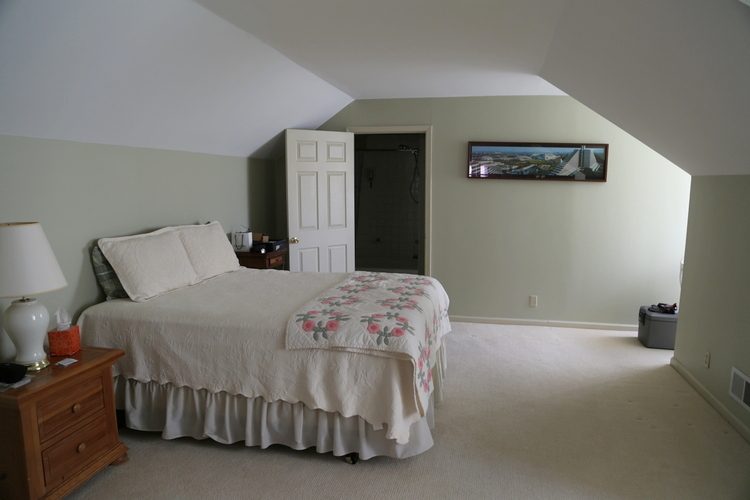
Attic bedrooms often feature dramatic, low-slung slanted ceilings that can feel oppressive. The goal here is usually to expand the perception of space and bring in as much light as possible.
- Paint Solution: Employ the Monochromatic Embrace (Strategy 1) with a very light, cool-toned white or a pale, barely-there gray or blue throughout. This creates a seamless envelope, making the angles recede and the room feel much larger and airier.
- Why it works: By eliminating visual breaks, your eye perceives one continuous surface, pushing the boundaries of the room outwards.
The Small Room Challenge: Optical Illusions for Space
A small bedroom with slanted ceilings can easily feel like a cramped box. Paint is a powerful tool to create optical illusions that counteract this.
- Paint Solution: Use the Monochromatic Embrace (Strategy 1) with a light, reflective color (like a soft white or a very light pastel). Alternatively, for a slightly more defined look, use the Traditional Divide (Strategy 3) by painting the lowest vertical walls a slightly darker shade than the slanted ceiling, which remains light. This makes the vertical walls appear to “anchor” the room while the ceiling lifts.
- Why it works: Light colors expand; a slight contrast on lower walls can ground the room without making the ceiling feel heavy or low.
The High-Pitched Cathedral: Creating Intimacy
A very high, open-pitched ceiling can make a bedroom feel cold and impersonal. Here, we want to bring the space down and create a sense of snug comfort.
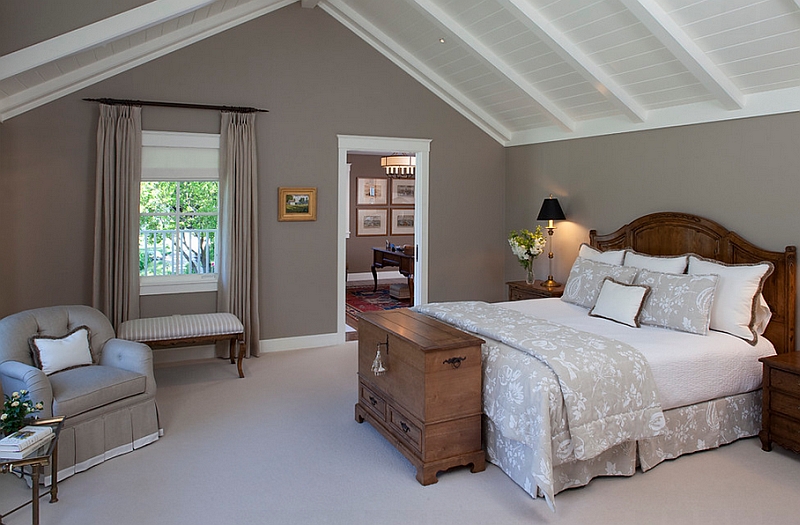
- Paint Solution: Opt for the Monochromatic Embrace (Strategy 1) with a medium to deep, warm color (think charcoal gray, forest green, or a rich taupe). The continuous darker color will visually lower the ceiling and envelop the space.
- Why it works: Darker colors absorb light and visually recede, making vast spaces feel more contained and cozy.
The Awkward Nook: Turning Dead Space into a Feature
Slanted ceilings often create odd nooks and crannies. Instead of ignoring them, turn them into intentional design elements.
- Paint Solution: Use the Accent Angle (Strategy 2) to highlight a specific nook. Paint the inside of a window dormer, a built-in shelf under a slant, or a small alcove in a vibrant or contrasting color.
- Why it works: Drawing attention to these unique features transforms them from awkward spaces to charming focal points, making the most of the architecture.
Your bedroom with slanted ceilings is a canvas waiting for a thoughtful hand. By understanding how light and color interact with these unique angles, you can move beyond simply covering surfaces to truly designing your space. So, grab your swatches, embrace those slopes, and get ready to create a bedroom that’s not just lived in, but loved.
Frequently Asked Questions
What is the best paint strategy for small bedrooms with slanted ceilings?
For small bedrooms, the ‘Monochromatic Embrace’ strategy is highly effective. Paint the walls and all slanted ceiling planes the exact same light, cool-toned color (e.g., a soft white, pale gray, or light blue). This creates a seamless, expansive feel, blurring the boundaries and making the room appear larger and airier.
Should I paint slanted ceilings the same color as the walls or a different color?
It depends on your desired effect. Painting them the same color (monochromatic) creates a unified, spacious, and cozy feel. Painting them a different, lighter color can brighten the room and provide a classic look, but might visually chop up the space. Using a contrasting accent color on one slant can create a focal point.
What kind of paint finish is best for slanted ceilings?
Flat or matte finishes are generally best for slanted ceilings in bedrooms. They absorb light, helping to hide minor imperfections and create a soft, sophisticated look. Eggshell or satin finishes are also good, offering slightly more durability and washability with a subtle sheen, but may reveal more imperfections than matte.
How do I make a very high slanted ceiling feel cozier?
To make a high slanted ceiling feel more intimate and cozy, consider using a medium to deep, warm color in a monochromatic scheme (painting both walls and the entire slanted ceiling the same hue). Rich colors like charcoal gray, forest green, navy blue, or deep taupe absorb light, visually lowering the ceiling and creating an enveloping, comforting atmosphere.
Where should I draw the line when painting a slanted ceiling a different color than the walls?
When creating a division, the cleanest visual line is often drawn at the lowest horizontal point where the slanted ceiling meets a vertical wall, or where it visually feels natural to delineate the space. Use high-quality painter’s tape and a precise cut-in technique to achieve a razor-sharp line.
Can I use bold or dark colors on a slanted ceiling?
Absolutely! Bold or dark colors can be incredibly effective, especially in larger rooms or when aiming for a dramatic, intimate, or sophisticated aesthetic. They work best with the ‘Monochromatic Embrace’ strategy or as an ‘Accent Angle’ to create a powerful focal point. Just ensure there’s enough natural or artificial light to balance the depth of the color, preventing the room from feeling too cavernous.