How Much Paint For An Interior Door? Your Definitive Guide to Flawless Coverage
Ever stood in the paint aisle, staring at cans, wondering if a quart is enough for your interior door, or if you’ll end up with a gallon you barely touch? You’re not alone. Figuring out exactly how much paint for an interior door is a common DIY headache, leading to frustrating extra trips to the store or wasted money on too much paint.
But what if I told you that with a little knowledge, you could nail your paint estimate every single time? No more guesswork, no more last-minute runs. You’re about to get the definitive answers, practical calculations, and expert tips needed to ensure your interior doors get the perfect, lasting finish they deserve.
Let’s dive in and take the mystery out of door painting!
The Quick Answer: How Much Paint Do You REALLY Need for a Single Door?
Alright, let’s get straight to it. For a standard interior door, here’s your rule of thumb:
- One standard interior door (flat or paneled, both sides): Expect to need approximately 1 quart (32 oz) of paint for two coats.
- If you’re only doing one side, or a very small door, a pint (16 oz) *might suffice for two coats, but it’s often cutting it too close. A quart is generally a safer bet.
This estimate assumes you’re painting a typical door (around 30-32 inches wide by 80 inches high) with two coats of paint, which is almost always recommended for durability and color vibrancy. Keep in mind, this doesn’t usually include the door frame or trim – we’re talking about the door slab itself.
Here’s a quick glance at typical needs:
| Door Type | Approx. Surface Area (Both Sides) | Paint Needed (2 Coats) | Primer Needed (1 Coat) |
|---|---|---|---|
| Standard Flat/Slab Door (30″x80″ – 32″x80″) | ~33-36 sq ft | 1 Quart | ~1/2 Quart |
| Standard Paneled Door (e.g., 6-panel) | ~38-42 sq ft | 1 Quart (closer to full quart) | ~1/2 Quart |
| Standard Bi-Fold/Louvered Door (Higher surface area) | ~45-60+ sq ft | 1 Quart (may need slightly more for very louvered) | ~3/4 Quart |
Now, let’s unpack all the factors that can slightly shift these numbers, ensuring you get it just right for your specific project.
Beyond the Basics: Factors That Influence Your Paint Quantity
While the quick answer gives you a solid starting point, the truth is, not all doors (or painting projects) are created equal. Several variables can push your paint needs up or down. Understanding these will make you a truly savvy painter.
Door Dimensions & Type: Flat, Paneled, or Louvered?
This is arguably the biggest factor after the number of coats. The actual surface area you need to cover can vary significantly:
- Flat/Slab Doors: These are the simplest. A standard 32-inch by 80-inch door has a surface area of 2,560 square inches (3280) per side. Multiplied by two sides, that’s 5,120 square inches, or roughly 35.5 square feet. This is the baseline.
- Paneled Doors: The recesses and raised edges of paneled doors (like 6-panel or 2-panel designs) add considerable surface area. While the footprint might be the same as a flat door, the actual area to paint can be 15-20% higher. This means our 35.5 sq ft might jump to 40-42 sq ft.
- Louvered or Bi-Fold Doors: These can be paint thirsty! The slats and intricate angles mean you’re painting a much larger effective surface area. A louvered door can easily have 30-50% more surface area than a flat door of the same dimensions, sometimes even more.
Always consider the complexity of your door’s design when estimating.
The Number of Coats: One and Done, or Two for the Win?
Here’s a golden rule: almost all interior door painting projects benefit from (and typically require) two coats of paint. Why?
- Color Depth & Consistency: One coat often looks streaky or uneven, especially if you’re changing a color significantly. Two coats provide a rich, uniform color.
- Durability: Doors take a beating. They’re opened, closed, kicked, and touched constantly. Two coats offer significantly better protection against scuffs, chips, and daily wear and tear.
- Adhesion: The second coat often adheres better to the first, creating a stronger, more resilient film.
While some high-quality paint-and-primer-in-one products *claim* one-coat coverage, for doors – which are high-traffic surfaces – I always recommend a second coat for optimal results.
Paint Type & Finish: Sheen, Solids, and Spread Rates
Not all paints are created equal, and their coverage rates can vary. Most interior paints will cover approximately 350-400 square feet per gallon, per coat. For a quart, that’s roughly 87.5-100 square feet per coat.
- Quality Matters: Higher quality paints often have higher solids content, meaning they provide better coverage in fewer coats. They might cost more upfront but save you time and potentially paint.
- Primer: Primers typically have different spread rates, sometimes slightly less than topcoats (around 200-300 sq ft per gallon).
- Sheen: While less significant than other factors, higher sheen paints (like semi-gloss or high-gloss, commonly used on doors) can sometimes feel like they spread a tiny bit less than flat paints due to their different viscosity. However, this difference is usually negligible for small areas like doors.
Always check the manufacturer’s recommendations on the paint can for exact coverage rates.
Application Method: Brush & Roller vs. Sprayer
How you apply the paint directly impacts how much you use:
- Brush and Roller: This is the most common DIY method for doors. It’s efficient, with minimal waste from overspray. You’ll typically get very close to the manufacturer’s stated coverage rates.
- Paint Sprayer: Sprayers offer a beautifully smooth, factory-like finish. However, they can lead to significant paint waste due to overspray and the need to thin some paints. When spraying, expect to use anywhere from 25-50% more paint than you would with a brush and roller for the same coverage. This waste is often balanced by the speed and superior finish, but it’s a critical factor for your paint quantity.
Original Door Color & New Color Choice
The contrast between your old and new colors is a big deal:
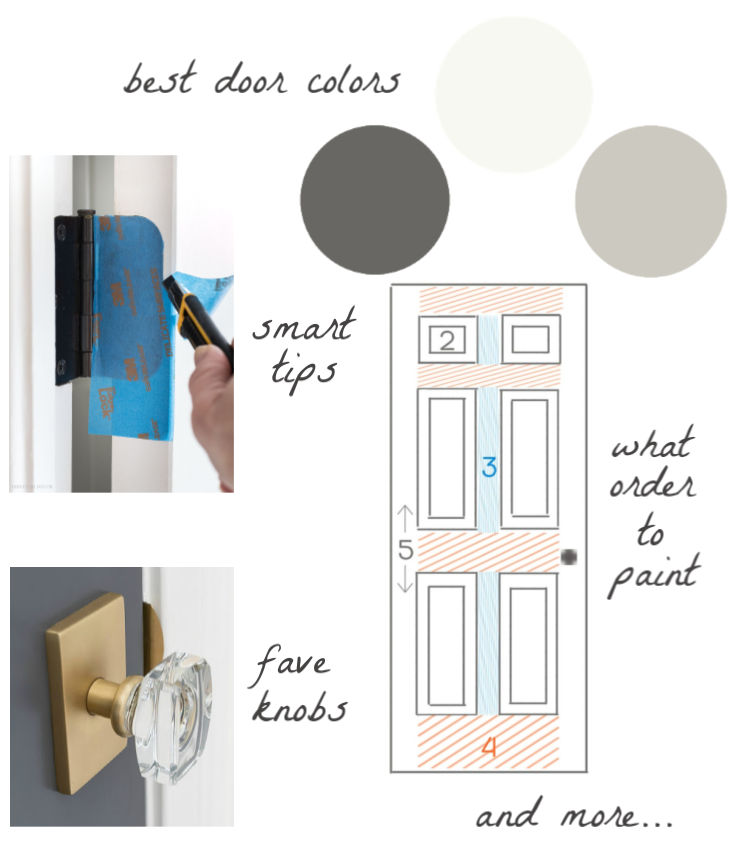
- Dark to Light: If you’re going from a dark brown door to a crisp white, you will absolutely need a good quality primer (tinted if possible) and likely a full two coats of your chosen topcoat. You might even consider three topcoats for the absolute best, most opaque finish.
- Light to Dark: This transition is generally easier. A good primer might still be advisable for adhesion, but you might achieve excellent coverage with two topcoats without much struggle.
- Similar Colors: Painting a light beige over a slightly darker light beige will be the easiest and might even get away with just one solid coat (though still not recommended for durability).
Condition of the Door Surface
A porous, unsealed, or rough door surface (like raw wood or a poorly prepped door) will absorb more paint on the first coat than a smooth, pre-primed, or previously painted surface. Proper sanding and cleaning are not just for aesthetics; they help optimize paint adhesion and coverage.
Calculating Your Exact Paint Needs: No More Guesswork!
Ready to get scientific? Here’s how to calculate precisely how much paint you’ll need for your interior doors, taking into account all the factors we just discussed.
Step-by-Step Measurement Guide
First, grab your tape measure. Accuracy here pays off!
- Measure Height: Measure from the top of the door to the bottom.
- Measure Width: Measure from one side of the door to the other.
- Calculate Single Side Area: Multiply Height (in inches) by Width (in inches). For example, 32 inches x 80 inches = 2,560 sq inches.
- Convert to Square Feet: Divide the square inches by 144 (since 1 square foot = 144 square inches). So, 2,560 / 144 = approximately 17.78 sq ft for one side.
- Account for Both Sides: Multiply your single-side square footage by 2. For our example, 17.78 sq ft * 2 = approximately 35.56 sq ft. This is your total flat surface area.
- Estimate for Paneled/Louvered Doors:
- Paneled Doors: Add 15-20% to your flat surface area. (35.56 sq ft * 1.15 = ~40.9 sq ft) to (35.56 sq ft * 1.20 = ~42.7 sq ft)
- Louvered/Bi-Fold Doors: Add 30-50% or more. (35.56 sq ft * 1.30 = ~46.2 sq ft) to (35.56 sq ft * 1.50 = ~53.3 sq ft)
Important Note: While door frames (jambs) and trim also need paint, this guide focuses primarily on the door slab itself. If you’re painting the trim too, you’ll need to calculate that separately. A good rule of thumb for average trim around one interior door is to add another 10-15 square feet of surface area to your total calculation, depending on the trim’s width and design.
The Paint Math Formula
Once you have your total estimated surface area for the door (including extra for panels/louvers), you’re ready for the paint math!
Formula:
(Total Estimated Surface Area per door * Number of Doors * Number of Coats) / Paint's Coverage Rate per Gallon = Gallons of Paint Needed
Let’s use our example of a standard 32″x80″ paneled door, wanting two coats, and a paint that covers 350 sq ft per gallon:

- Total Surface Area for ONE Paneled Door: Let’s use 42 sq ft (our 35.56 sq ft + ~20% for panels).
- Number of Coats: 2
- Paint Coverage Rate: 350 sq ft/gallon
(42 sq ft * 1 door * 2 coats) / 350 sq ft/gallon = 84 / 350 = 0.24 gallons
Since 1 quart is 0.25 gallons, this confirms that one quart of paint is almost perfect for one standard paneled door with two coats. If you were painting multiple doors, say 5 doors:
(42 sq ft * 5 doors * 2 coats) / 350 sq ft/gallon = 420 / 350 = 1.2 gallons
In this case, you’d need slightly more than a gallon, so you’d buy one gallon and one quart to be safe. Always round up to the nearest purchasable container size.
Don’t Forget the Primer!
Primer is your secret weapon for a professional, durable finish, especially if you’re:
- Painting raw wood or new doors.
- Changing from a dark color to a light color.
- Dealing with stained or glossy surfaces.
- Using a paint that isn’t a ‘paint-and-primer-in-one’ product.
Primer typically covers about 200-300 sq ft per gallon. Using our paneled door example (42 sq ft per door), and assuming one coat of primer:
(42 sq ft * 1 door * 1 coat) / 250 sq ft/gallon (average primer rate) = 42 / 250 = 0.168 gallons
This means for one door, a half-pint of primer would be more than enough, but most primers come in quart sizes, which would cover several doors. For 5 doors:

(42 sq ft * 5 doors * 1 coat) / 250 sq ft/gallon = 210 / 250 = 0.84 gallons
So, for 5 doors, one gallon of primer would be a good purchase, leaving you with a little leftover.
Essential Tools & Materials for Your Door Painting Project
Having the right gear makes all the difference for a smooth, efficient, and high-quality finish. Don’t skimp on these!
- Paint & Primer: The star of the show, in your chosen color and finish.
- Brushes: A high-quality 2-2.5 inch angled sash brush is ideal for cutting in around hardware and working into panel recesses.
- Rollers: Small foam rollers (4-6 inches) or very short nap (1/4 inch) microfiber rollers are perfect for smooth application on flat door surfaces.
- Roller Tray/Liner: Makes loading your roller easy and cleanup a breeze.
- Painter’s Tape: High-quality painter’s tape for masking hinges, door stops, or areas you don’t want to paint.
- Drop Cloths/Plastic Sheeting: Protect your floors and surrounding areas.
- Sandpaper/Sanding Block: Fine-grit (220-320) sandpaper for light sanding between coats and prep.
- Screwdriver: To remove door knobs, hinges, and other hardware. This is CRUCIAL for a professional look.
- Cleaner/Degreaser: TSP substitute or a mild household cleaner to ensure a clean, grease-free surface.
- Wood Filler/Putty Knife: For repairing any dings or holes.
- Tack Cloths: To wipe away sanding dust before painting.
- Stir Sticks: To thoroughly mix your paint.
The Process: Painting Your Interior Door Like a Pro (Brief Overview)
Knowing how much paint you need is just one piece of the puzzle. Here’s a condensed version of the painting process to ensure you use that paint effectively and achieve beautiful results:
- Prep is Key (Don’t Skip This!):
- Remove Hardware: Take off door knobs, hinges, strike plates, and any other attached hardware. It takes a little more time, but the results are infinitely better than trying to paint around them.
- Clean Thoroughly: Wash the door with a cleaner/degreaser to remove dirt, grease, and grime. Rinse well and let dry completely.
- Repair & Sand: Fill any holes or dents with wood filler, sand smooth, then lightly sand the entire door surface (even if previously painted) with 220-grit sandpaper to create a ‘tooth’ for the paint to adhere to. Wipe clean with a tack cloth to remove all dust.
- Tape Off (if not removing door): If you can’t remove the door, use painter’s tape to mask off hinges and any areas you absolutely don’t want paint.
- Prime (When Necessary): Apply a thin, even coat of primer if you’re going from dark to light, painting raw wood, or using a non-priming paint. Let it dry completely according to manufacturer instructions.
- Paint Your First Coat:
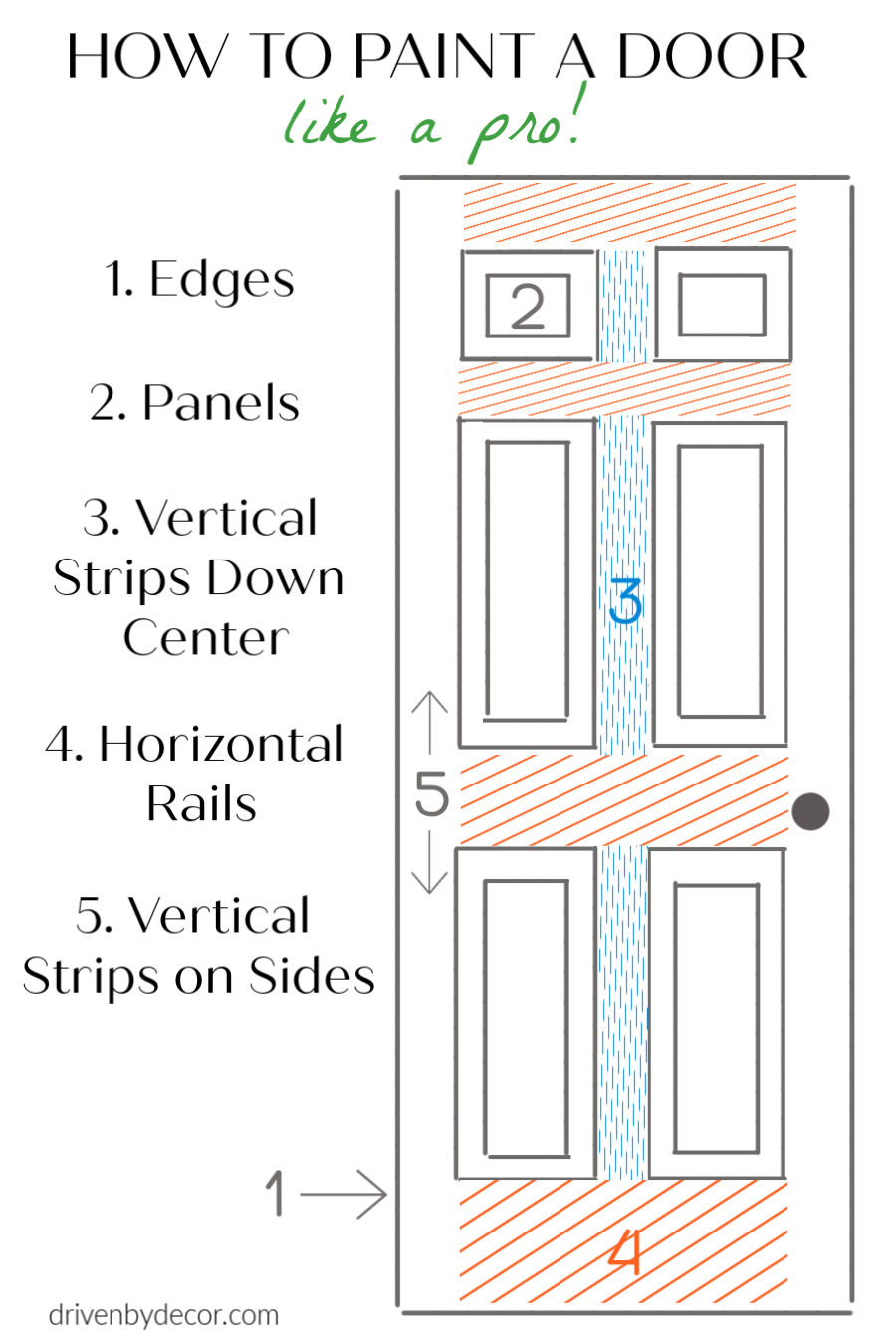
- If your door is paneled, start with the recessed panels, then the horizontal rails, then the vertical stiles.
- For flat doors, use a roller for the main flat surfaces and a brush for edges.
- Apply thin, even coats. Avoid overloading your brush or roller to prevent drips.
- Light Sand & Second Coat: Once the first coat is dry (check can for recoat times), lightly sand the entire surface with very fine (320-grit) sandpaper. This smooths out any minor imperfections and helps the second coat adhere better. Wipe clean with a tack cloth. Apply your second, thin coat of paint following the same method as the first.
- Dry & Cure: Let your doors dry completely before reattaching hardware or closing them fully. Paint is dry to the touch much faster than it is fully ‘cured’ (hardened). Follow the can’s instructions, but often 24-48 hours before moderate use, and longer for full hardness.
Cost Considerations: What Will Your Door Paint Project Really Cost?
Understanding paint quantity also helps you budget effectively. Here’s a breakdown of potential costs for painting a single interior door (excluding labor if you DIY):
| Item | Estimated Cost (per door, assuming 1 qt paint/primer for multiple doors) | Notes |
|---|---|---|
| Paint (1 quart) | $15 – $30 | Quality interior enamel, satin/semi-gloss. Prices vary by brand. |
| Primer (1/2 quart portion of a larger can) | $5 – $10 | Assumes buying a gallon or quart and using a portion. |
| Brushes (1-2 quality brushes) | $10 – $25 (one-time purchase) | Good brushes are reusable. Initial investment. |
| Rollers (1-2 foam/microfiber) | $5 – $10 | Small rollers are relatively inexpensive. |
| Painter’s Tape | $2 – $5 | Per door, for protecting hinges/edges. |
| Sandpaper/Tack Cloths | $1 – $3 | Minimal cost, but essential. |
| Cleaner/Degreaser | $1 – $2 | A small portion of a larger bottle. |
| Drop Cloths (reusable) | $0 (if you already have) – $5 (if buying a small sheet) | Good for multiple projects. |
| Total Estimated Cost Per Door (DIY) | $39 – $90 | Assumes buying necessary tools. Can be lower if reusing. |
Remember, while the initial tool investment might seem high, many items (like brushes, screwdrivers, drop cloths) are reusable for future projects, bringing the per-door cost down significantly over time.
Expert Tips for a Flawless Finish
You’ve got the paint, you’ve got the tools, and you know the process. Now, let’s sprinkle in some pro tips to elevate your door painting from ‘DIY adequate’ to ‘wow, you did that?!’
- Work Horizontally (If Possible): The absolute best way to paint a door is to remove it from its hinges and lay it flat on sawhorses. This eliminates drips and allows gravity to help the paint level out for a smoother finish.
- Ventilation is Your Friend: Always paint in a well-ventilated area. Open windows, use fans (not directly blowing on the wet paint), and wear a respirator, especially with oil-based paints.
- Thin Coats are Better: Resist the urge to slap on a thick coat to save time. Thick coats lead to drips, sags, and an uneven finish. Two thin, even coats are always superior.
- Cut In Before Rolling: If you’re brushing and rolling, use your brush to paint the recesses of panels and the edges first, then immediately follow up with your roller on the flat surfaces while the brushed paint is still wet. This helps blend brush strokes.
- Maintain a Wet Edge: Work in sections and try to always paint into a ‘wet edge.’ This means applying new paint next to paint that’s still wet, preventing lap marks.
- Don’t Overwork the Paint: Once you’ve applied paint to an area, leave it alone. Excessive brushing or rolling will cause the paint to dry unevenly and create texture.
- Clean As You Go: If you get a drip or a stray mark, wipe it immediately with a damp cloth before it dries.
- Patience, Patience, Patience: Rushing the drying and curing process is a common mistake. Allow ample time between coats and before putting hardware back on or fully closing the door.
The Final Stroke: Enjoy Your Beautifully Painted Doors
Painting interior doors is a fantastic way to refresh a room, update your home’s aesthetic, and add a touch of personality. By understanding how much paint for an interior door you truly need, factoring in door type, coats, and application, you’ve already won half the battle.
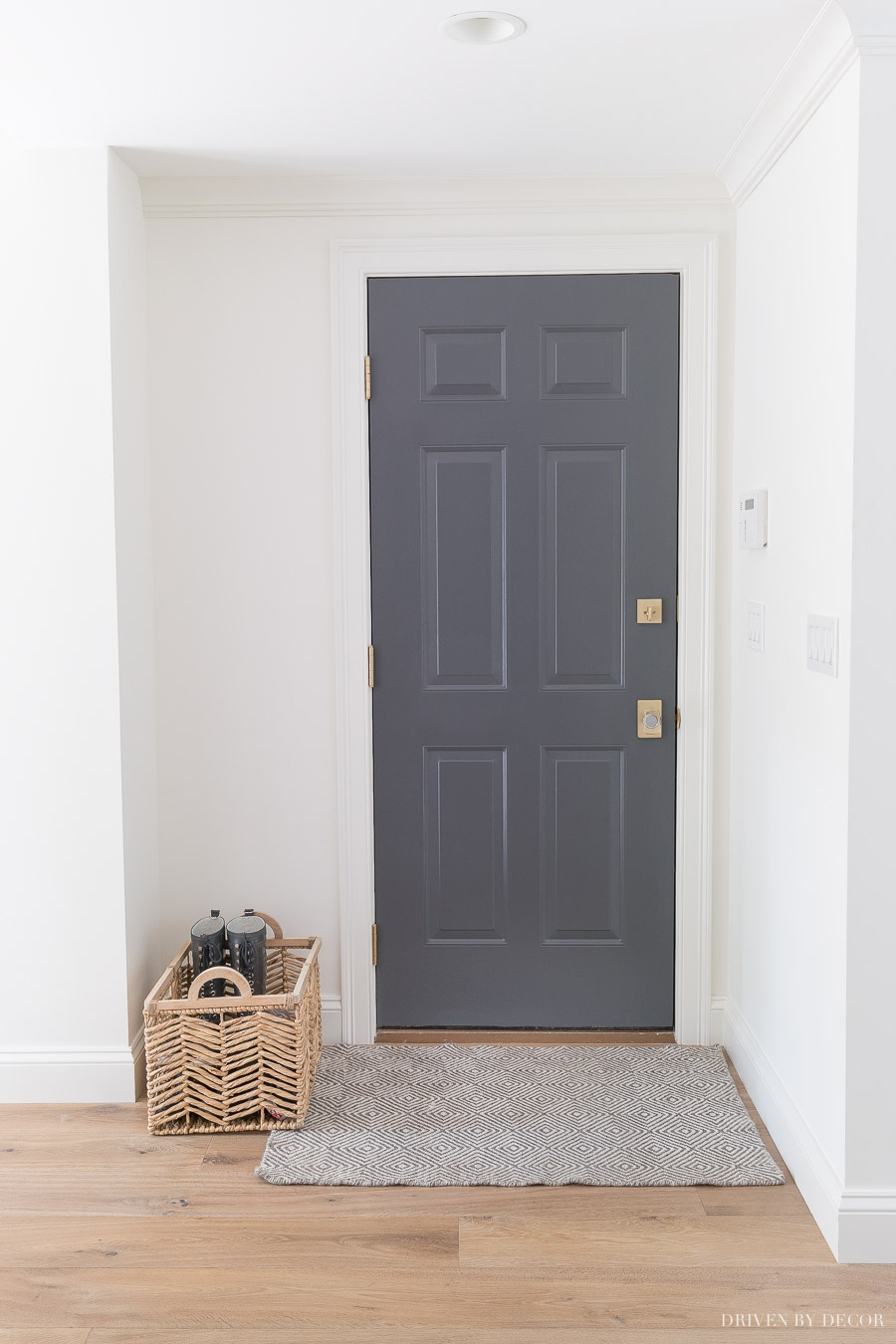
No more paint panic. Just smooth, durable, and perfectly painted doors that look like a professional did them. Now go forth, measure wisely, paint confidently, and transform your space!
Frequently Asked Questions
How many interior doors can one gallon of paint cover?
A gallon of interior paint, which typically covers 350-400 square feet per coat, can cover approximately 8 to 10 standard interior doors (32″x80″ paneled) with two coats on both sides. This estimate accounts for the increased surface area of paneled doors and standard paint waste.
Will a quart of paint cover one interior door?
Yes, a quart (32 oz) of quality interior paint is generally sufficient to cover one standard interior door (flat or paneled, both sides) with two coats. This assumes an average door size and minimal waste.
Do I need to prime an interior door before painting?
You should almost always prime an interior door, especially if it’s raw wood, you’re making a significant color change (dark to light), or the existing surface is glossy or stained. Primer ensures better adhesion, true color representation, and a more durable final finish.
How do I calculate the surface area of a paneled door?
Start by calculating the flat surface area: (Door Height x Door Width x 2 sides). Then, add an additional 15-20% to this total to account for the increased surface area from the panels, recesses, and raised edges. For example, a 32″x80″ door is about 35.5 sq ft flat; add 20% to get roughly 42 sq ft.
Is it better to brush, roll, or spray paint an interior door?
Each method has pros and cons. Brushing and rolling is most common for DIY, offers good control, and less paint waste. Spraying provides a smoother, factory-like finish but requires more prep (masking) and typically uses 25-50% more paint due to overspray. For most DIYers, a combination of brushing for details and rolling for flat surfaces is ideal.
How long does it take for painted interior doors to dry completely?
Paint is typically ‘dry to the touch’ in 1-4 hours and ready for a second coat in 4-8 hours, depending on humidity and paint type. However, for full ‘curing’ (when the paint hardens completely and achieves maximum durability), it can take 7 to 30 days. Avoid heavy use or banging the door during the curing period.
What kind of paint finish is best for interior doors?
Semi-gloss or satin finishes are generally best for interior doors. These sheens are durable, easy to clean, and resistant to scuffs and fingerprints, making them ideal for high-traffic areas. They also provide a subtle sheen that enhances the door’s architectural details.