How Many Litres (and Gallons!) of Paint Do You Really Need for a 4-Bedroom House? Your Expert Guide
Staring down a full-house painting project can feel like staring at a blank canvas with no idea where to start. “How much paint?” is the first, often overwhelming, question on every homeowner’s mind, especially when you’re tackling something as substantial as a 4-bedroom house. You don’t want to run short halfway through a wall, and you certainly don’t want to buy so much you’re tripping over leftover cans for years.
Let’s cut to the chase and demystify the paint estimation process. Forget generic calculators that only work if you know every dimension down to the millimeter. You’re here for practical, real-world numbers for a typical 4-bedroom home. We’re going to give you those ballpark figures, then dive deep into how you can refine them for your specific situation, covering everything from walls and ceilings to trim and primer.
Whether you think in litres or gallons, we’ve got you covered for your next big project.
The Quick Answer: Ballpark Estimates for Your 4-Bedroom Home (Interior Walls)
Alright, let’s get right to it. For an average 4-bedroom house, focusing just on the interior walls and assuming two coats of paint (which is standard for good coverage and color depth), you’re looking at a significant amount of paint. Remember, this is an average – your house might be larger or smaller, have higher ceilings, or require more coats.
For a typical 4-bedroom home (approximately 1,800 to 2,500 square feet of living space), you’ll generally need between 20 to 30 gallons of interior paint. If you’re thinking in litres, that’s roughly 75 to 115 litres.
Here’s a quick visual:

| Area to Paint | Estimated Square Footage | Estimated Paint Needed (Gallons, 2 Coats) | Estimated Paint Needed (Litres, 2 Coats) |
|---|---|---|---|
| Interior Walls (Total House) | 4,500 – 7,000 sq ft | 20 – 30 Gallons | 75 – 115 Litres |
| Ceilings (Total House) | 1,800 – 2,500 sq ft | 5 – 8 Gallons | 19 – 30 Litres |
| Primer (Total Walls) | 4,500 – 7,000 sq ft | 15 – 25 Gallons | 57 – 95 Litres |
These numbers are a solid starting point, but they’re just that – a starting point. Your actual needs will depend on several critical factors we’ll explore next.
Breaking It Down: Paint Estimates Room-by-Room for a 4-Bedroom House
Most 4-bedroom houses include a master bedroom, three additional bedrooms, multiple bathrooms, a living room, kitchen, dining area, and hallways. Let’s look at average paint needs for each area, assuming standard 8-foot ceilings and two coats of paint. A typical gallon of paint covers about 350-400 square feet (33-37 square meters) per coat.
| Room Type | Avg. Wall Area (sq ft) | Est. Paint (Gallons, 2 Coats) | Est. Paint (Litres, 2 Coats) | Notes |
|---|---|---|---|---|
| Master Bedroom (15×15 ft) | ~480 sq ft | 2.5 – 3 Gallons | 9.5 – 11.5 Litres | Often includes larger wall space, possibly an accent wall. |
| Standard Bedrooms (3) (10×12 ft each) | ~350 sq ft each | 1.5 – 2 Gallons each (4.5 – 6 total) | 6 – 7.5 Litres each (18 – 22.5 total) | Factor in closets and window sizes. |
| Living Room / Great Room (18×20 ft) | ~600 sq ft | 3 – 4 Gallons | 11.5 – 15 Litres | High traffic, consider more durable finishes. Open concept may connect to dining. |
| Kitchen & Dining Area (12×15 ft, combined) | ~400 sq ft | 2 – 2.5 Gallons | 7.5 – 9.5 Litres | Kitchens have less wall space due to cabinets. Use scrubbable paint. |
| Bathrooms (2-3) (8×5 ft each) | ~150 sq ft each | 0.75 – 1 Gallon each (2.25 – 3 total for 3 baths) | 3 – 4 Litres each (9 – 12 total for 3 baths) | Small spaces, but high humidity. Ensure you use mildew-resistant paint. |
| Hallways & Stairwells (Variable) | ~400-600 sq ft | 2 – 3.5 Gallons | 7.5 – 13 Litres | Can be surprisingly large. High traffic areas. |
| Ceilings (Entire House) | ~1,800-2,500 sq ft | 5 – 8 Gallons | 19 – 30 Litres | Often a different paint (flat finish). |
| Trim & Doors (Entire House) | ~200-300 linear ft trim + 8-10 doors | 1 – 2 Gallons | 4 – 7.5 Litres | Often a different finish (semi-gloss). |
Master Bedroom
Your master suite is likely the largest bedroom, often including a walk-in closet and sometimes an attached bathroom (which we’ve covered separately). For a room around 15×15 feet with standard 8-foot ceilings, you’re looking at approximately 480 square feet of wall space. Plan for 2.5 to 3 gallons (9.5 to 11.5 litres) for two coats. If you have higher ceilings or a particularly large master, bump that up slightly.
Standard Bedrooms (3)
For the other three bedrooms, assuming average sizes of 10×12 feet, each room has roughly 350 square feet of wall space. Each will need about 1.5 to 2 gallons (6 to 7.5 litres) for two coats. So, for three standard bedrooms, you’d calculate 4.5 to 6 gallons (18 to 22.5 litres) in total.
Living Room / Great Room
This is often the largest single painted area. For an 18×20 foot living room, you could easily have 600 square feet of wall space. Expect to need 3 to 4 gallons (11.5 to 15 litres) for two coats. Open-concept layouts may merge with dining or entryways, meaning you’ll need to calculate a larger continuous area.
Kitchen & Dining Area
Kitchens usually have less exposed wall space due to cabinets and backsplashes, but dining areas can be quite open. For a combined 12×15 foot space, around 400 square feet of paintable wall, you’ll need about 2 to 2.5 gallons (7.5 to 9.5 litres). Remember, kitchen paint needs to be durable and scrubbable!
Bathrooms (2-3)
Bathrooms are small but critical. For an average 8×5 foot bathroom, you’re looking at about 150 square feet of wall space. One gallon (3.78 litres) is usually sufficient for two coats in one bathroom, so for two to three bathrooms, budget for 2 to 3 gallons (7.5 to 11.5 litres). Always opt for paint with mildew resistance in these high-humidity zones.
Hallways & Stairwells
These areas are often underestimated. They might not be wide, but they can be long and tall, especially stairwells. For a typical 4-bedroom house, budget for 2 to 3.5 gallons (7.5 to 13 litres) depending on the layout and length. It’s often safer to round up here, as measuring these can be tricky.
Ceilings
Don’t forget the fifth wall! If you’re painting ceilings, you’ll need a different type of paint (usually a flat, dedicated ceiling paint). The square footage of your ceilings is roughly the total square footage of your home. For 1,800 to 2,500 square feet of ceiling, you’ll need around 5 to 8 gallons (19 to 30 litres) for two coats.
Trim & Doors
Trim (baseboards, crown molding, window casings) and doors add up. While their area isn’t massive, they often require a different type and sheen of paint (like semi-gloss). A good rule of thumb is that 1 to 2 gallons (4 to 7.5 litres) should cover all the trim and interior doors for a 4-bedroom house with two coats.
The Nitty-Gritty: Factors That REALLY Influence Your Paint Quantity
These room-by-room estimates are a fantastic starting point, but true precision comes from understanding the variables that can either save you paint or leave you scrambling for more.
Surface Area is King: Walls, Ceilings, and More
The most fundamental factor is the total surface area you intend to cover. This means measuring the length and height of every wall, the length and width of every ceiling. Even within a room, don’t forget closets or alcoves.

- How to Measure: For each wall, measure its length and height. Multiply these numbers to get the square footage. Add all wall areas together.
- Subtracting Non-Paintable Areas: You don’t paint windows, doors, or permanent built-in fixtures. Measure these areas and subtract them from your total wall square footage. While many pros skip this for small windows/doors to build in a buffer, for large openings, it’s worth doing.
Number of Coats: The Double-Dip Reality
Almost every interior painting project requires two coats of paint for a smooth, uniform, and durable finish. A single coat rarely provides adequate coverage or color depth, especially if you’re making a significant color change.
- Two Coats: This is the baseline. Your paint calculations should always assume two coats.
- Three (or More) Coats: You might need extra coats if you’re painting over a very dark color with a very light one, if the existing surface is highly textured, or if you’re using a particularly low-quality paint.
Current vs. New Color: A Dramatic Shift Requires More
The contrast between your old and new paint colors plays a huge role. Painting a light color over a dark one will almost certainly require more paint, often necessitating a primer coat (or a tinted primer) to block the old color and allow the new color to pop without extra coats.
Surface Condition & Texture: Smooth vs. Rough
Smooth, primed drywall absorbs less paint than rougher, textured surfaces like stucco, brick, or even heavily spackled and repaired walls. Textured surfaces have more surface area for the paint to adhere to, essentially meaning they “drink up” more paint.
Primer: The Essential First Layer
Primer is often overlooked but can be a huge paint-saver and quality enhancer. Primer creates a uniform base, seals porous surfaces, blocks stains, and improves paint adhesion. If you’re painting over new drywall, bare wood, glossy surfaces, or making a drastic color change, primer is non-negotiable.
- Coverage: Primer typically covers about 200-300 square feet per gallon (7.5-11.5 square meters per 3.78 litres), often requiring only one coat.
Paint Type & Quality: Not All Paint is Created Equal
You truly get what you pay for with paint. Higher-quality paints generally offer better coverage (they have more pigment and solids), requiring fewer coats and often providing a more durable finish. Cheaper paints might seem like a bargain, but you could end up buying more cans and spending more time painting.
Paint Finish (Sheen): Does It Affect Coverage?
While the sheen (flat, eggshell, satin, semi-gloss, high-gloss) doesn’t dramatically change the square footage coverage per gallon, it can slightly influence how many coats you *feel* you need for a perfect look. For instance, a high-gloss finish highlights imperfections, potentially leading you to apply an extra thin coat for flawless results.

Step-by-Step: How to Calculate Your EXACT Paint Needs (If You Want To)
If you prefer precision over estimates, here’s how to measure and calculate your paint needs like a pro:
- Measure Each Room:
- Measure the perimeter of the room (add the length of all four walls).
- Measure the height of the walls (from floor to ceiling).
- Multiply the perimeter by the height to get the total wall square footage for that room.
- Subtract Non-Paintable Areas:
- Measure the width and height of all windows and doors within that room.
- Multiply to get their square footage.
- Subtract these areas from the room’s total wall square footage. (As mentioned, for very small openings, you can skip this to build in a small buffer, but for many doors/windows, it’s worth it).
- Calculate Ceiling Area:
- Measure the length and width of the room.
- Multiply them to get the ceiling square footage.
- Factor in Coverage Rate:
- Check the paint can label for the typical coverage rate (usually 350-400 sq ft per gallon or 33-37 sq meters per 3.78 litres for one coat).
- Apply the Formula:
-
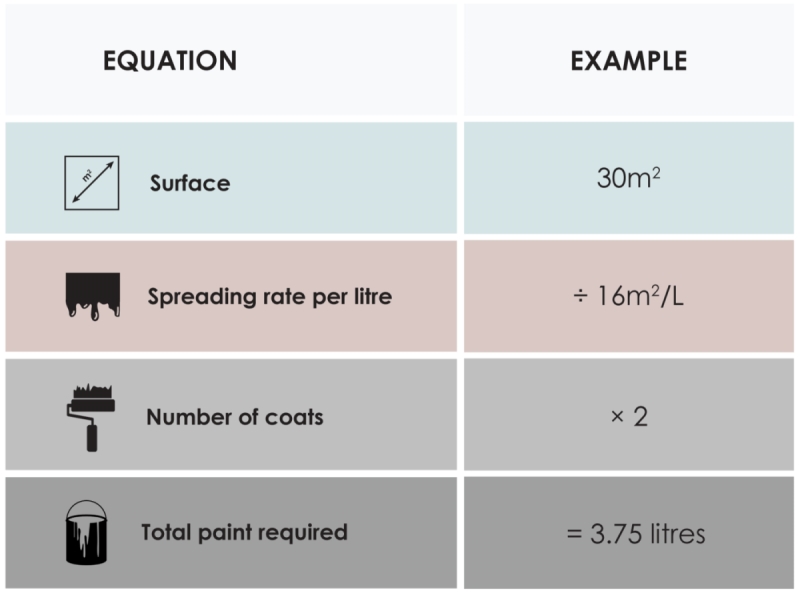
(Total Paintable Wall Area + Total Paintable Ceiling Area) / Paint Coverage Rate per Gallon (or Litre) = Paint Needed for One Coat
-
Paint Needed for One Coat * Number of Coats (usually 2) = Total Paint Required
-
- Add for Trim & Doors:
- Measure the linear feet of your baseboards and trim.
- Count your doors and window frames.
- Generally, 1 gallon (3.78 litres) of trim paint covers a substantial amount of trim and several doors with two coats.
Example Calculation for a single 10×12 ft bedroom with 8 ft ceilings:
- Perimeter: (10 + 12) * 2 = 44 ft
- Wall Area: 44 ft * 8 ft = 352 sq ft
- Subtract Door (3×7 ft): 21 sq ft. Subtract Window (3×4 ft): 12 sq ft.
- Paintable Wall Area: 352 – 21 – 12 = 319 sq ft
- Ceiling Area: 10 ft * 12 ft = 120 sq ft
- Total Interior Surface Area for this room: 319 sq ft (walls) + 120 sq ft (ceiling) = 439 sq ft
- Assuming coverage of 375 sq ft/gallon per coat:
- Paint for one coat: 439 sq ft / 375 sq ft/gallon = 1.17 gallons
- Paint for two coats: 1.17 gallons * 2 = 2.34 gallons (or approx. 8.8 litres)
See? Breaking it down makes it much less intimidating. Repeat this process for each room, then sum up your totals.
Don’t Forget the Extras: Primer and Trim Paint
These two often slip through the cracks of a paint estimate, but they are crucial for a professional-looking finish and shouldn’t be ignored.

Primer Needs
When do you absolutely need primer for your 4-bedroom house?
- New Drywall or Bare Wood: These surfaces are highly porous and will absorb paint unevenly without primer, leading to a splotchy finish.
- Drastic Color Change: Going from a dark red to a light beige? A tinted primer will save you at least one, if not two, coats of your more expensive topcoat paint.
- Stains or Odors: Water stains, smoke damage, crayon marks, or pet odors require a specialized stain-blocking primer to prevent bleed-through.
- Glossy Surfaces: To ensure new paint adheres to existing glossy paint or lacquer, use a bonding primer.
- Repairs: Patched areas of drywall can “flash” (show through the topcoat) if not primed first.
For an entire 4-bedroom house (walls only), if you’re priming everything, you’ll need around 15 to 25 gallons (57 to 95 litres) of primer for a single coat. Always check the primer can for its specific coverage rate.
Estimating Trim Paint
Trim includes baseboards, crown molding, door frames, window casings, and interior doors themselves. Since trim often gets painted a different color or sheen (typically a crisp white semi-gloss), it requires its own estimation.
- Linear Feet: A rough estimate is to take the perimeter of each room (for baseboards) and add in the linear feet for door and window frames.
- Doors: Count all your interior doors (usually 8-10 in a 4-bedroom house).
- General Rule: One gallon (3.78 litres) of trim paint goes a long way. For a 4-bedroom house, 1 to 2 gallons (4 to 7.5 litres) should be more than sufficient for two coats on all trim and doors.
Smart Buying Tips: Avoiding Shortages and Excess
Once you have your estimates, smart purchasing can save you headaches and money.
- Always Buy a Little Extra (10-15% Contingency): Paint coverage can vary slightly due to surface conditions, applicator technique, or color changes. Having an extra quart or half-gallon on hand is far better than stopping a project to buy more and potentially ending up with a slightly different shade if the store’s tinting machine is off.
- Keep Leftover Paint: Small amounts of leftover paint are perfect for touch-ups down the road. Store cans tightly sealed, upside down (to create a better seal), in a cool, dry place away from extreme temperatures. Label them clearly with the room, color name, and date.
- Check Return Policies: Most paint stores will allow returns of unopened, untinted gallons. Tinted paint is typically non-returnable. Always confirm before you buy.
- Bulk Discounts: If you’re buying a substantial amount of paint, inquire about bulk discounts. Many paint stores offer them.
Exterior Painting for a 4-Bedroom House: A Different Beast
While this guide focuses primarily on interior painting, it’s worth noting that exterior painting is a vastly different project with its own calculations. Exterior surfaces are exposed to weather, are often rougher (siding, stucco, brick), and frequently require specialized primers and paints designed for durability.
For a 4-bedroom house exterior, you could easily need 25 to 50 gallons (95 to 190 litres) of exterior paint, often requiring specific exterior primers. Factors like the number of stories, type of siding, and condition of existing paint dramatically impact the quantity. Always measure exterior walls carefully, subtracting windows and doors, and factor in more paint for textured surfaces.
Painting an entire 4-bedroom house is a significant undertaking, but with proper planning and accurate estimations, you can tackle it confidently. By understanding the average needs and the factors that influence them, you’re well on your way to a beautifully refreshed home.
n