How Many Liters of Paint For a Room? Your Definitive Calculation Guide
Staring at an empty room, a fresh paint swatch in hand, your mind probably races with excitement and… a little bit of dread. How many cans do I actually need? Buy too little, and you’re making extra trips to the store, risking color mismatches. Buy too much, and you’ve wasted money and now have leftover cans cluttering your garage. It’s a classic DIY dilemma, and you’re not alone.
Figuring out exactly how many liters of paint for a room is less about guesswork and more about simple measurements and a tiny bit of math. Forget those vague estimates. This guide will walk you through a foolproof method, ensuring you buy just the right amount, every single time. Let’s banish paint anxiety together.
The Quick Answer: A General Rule of Thumb for Room Painting
Before we dive deep, let’s start with a general guideline. For a typical interior room with standard walls and two coats of paint (which is almost always recommended for a good finish), you can expect:
- A single liter of paint generally covers about 10-12 square meters (approximately 100-130 square feet) per coat.
- Therefore, for two coats, one liter will cover roughly 5-6 square meters (approximately 50-65 square feet).
This means for a medium-sized bedroom (e.g., 3m x 4m or 10ft x 13ft), you might need around 8-12 liters of paint for the walls alone, depending on height and other factors. But remember, this is just a starting point.
Why a “General Rule” Isn’t Enough
While a quick estimate can give you an idea, it doesn’t account for crucial variables like ceiling height, windows, doors, surface texture, or the specific type of paint you choose. To truly get it right and avoid those annoying trips back to the hardware store, you need a more precise approach. That’s where our core formula comes in.
The Core Formula: Measuring Your Way to Perfect Paint Quantities
Don’t be intimidated by the word “formula.” We’re talking about basic arithmetic here, and I’ll walk you through each step. All you’ll need is a tape measure, a pencil, and a piece of paper.
Step 1: Measure Your Walls (The Bulk of the Work)
Your walls are the biggest surface area, so we’ll start here. The goal is to calculate the total square area of all your walls.
- Measure the Perimeter: Go around the room and measure the length of each wall. Add these lengths together to get the total perimeter. For example, if your room is 3 meters by 4 meters, your perimeter would be (3m + 4m + 3m + 4m) = 14 meters.
- Measure the Height: Measure the height of the walls from the floor to the ceiling. Ensure you measure in a few spots to account for any slight variations. Let’s say your walls are 2.5 meters high.
Calculating Total Wall Surface Area
Once you have these numbers, multiply the total perimeter by the wall height:

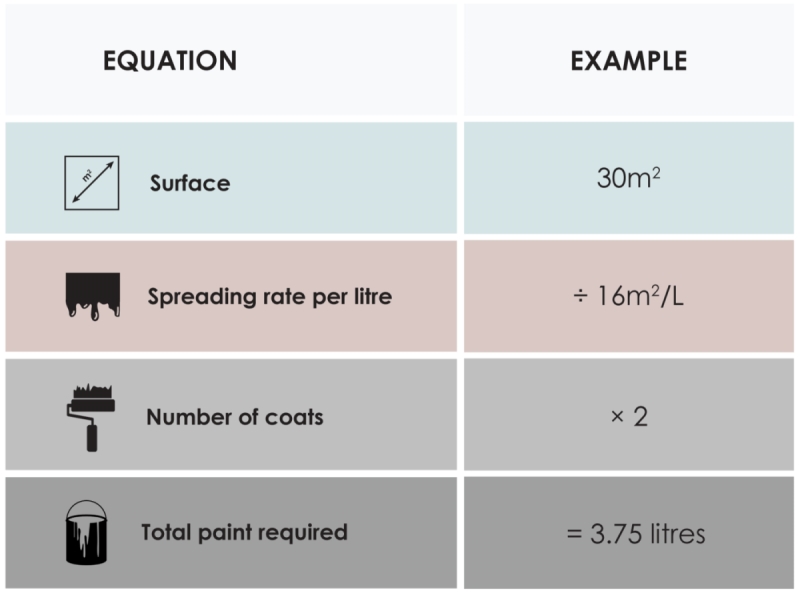
Total Wall Area (m²) = Room Perimeter (m) x Wall Height (m)
Using our example: 14 meters (perimeter) x 2.5 meters (height) = 35 square meters.
Step 2: Account for Doors and Windows (Subtracting the Unpainted)
You’re not painting your doors or windows, so we need to subtract their area from the total wall area. This is a crucial step that many calculators overlook, leading to overbuying.
- Measure each door: Typically, a standard interior door is around 0.8 meters wide by 2 meters high (1.6 m²).
- Measure each window: Measure the width and height of each window frame.
Add up the areas of all doors and windows. Let’s say your room has one door (1.6 m²) and one window (1.2m x 1.2m = 1.44 m²). Your total unpainted area is 1.6 m² + 1.44 m² = 3.04 square meters.
Now, subtract this from your total wall area:
35 m² (total wall area) – 3.04 m² (door/window area) = 31.96 square meters of paintable wall surface.
Step 3: Don’t Forget the Ceiling!
Many people focus solely on walls, but the ceiling can be a significant surface to paint. Its area is straightforward to calculate:
Ceiling Area (m²) = Room Length (m) x Room Width (m)
For our 3m x 4m room: 3 meters x 4 meters = 12 square meters.
You’ll typically use a different type of paint (and often a different color) for the ceiling, so calculate this separately.
Step 4: Add the Trim and Baseboards (The Finer Details)
Baseboards, crown molding, and door/window casings add significant detail and require paint, often a different finish like semi-gloss. It’s easier to calculate the linear footage/meterage for trim rather than square meters.
- Measure the linear length: Measure the total length of all baseboards, crown molding, and around door and window frames.
- Estimate for width: Since trim is narrow, paint coverage is often estimated per linear meter/foot rather than square area. A good rule of thumb is that 1 liter of trim paint can cover roughly 100-150 linear meters (300-500 linear feet) with two coats.
Let’s say your room has 14 meters of baseboard, plus 2 meters around the door and 1.2 meters x 4 sides = 4.8 meters around the window. Total linear trim: 14 + 2 + 4.8 = 20.8 linear meters.
The Magic Number: Understanding Paint Coverage Rates (Liters per Square Meter)
Now that you have your total surface areas, you need to know how much area a liter of paint covers. This isn’t a fixed number; it varies based on several factors, but here are some averages.
Average Coverage Rates for Common Paint Types (Primer, Wall, Ceiling, Trim)
These are general guidelines. Always check the specific paint can for the manufacturer’s recommended coverage.
| Paint Type | Average Coverage (per liter, 1 coat) | Average Coverage (per gallon, 1 coat) |
|---|---|---|
| Interior Wall Paint (latex/acrylic) | 10-12 m² | 35-45 m² (375-450 sq ft) |
| Primer | 8-10 m² | 30-37 m² (320-400 sq ft) |
| Ceiling Paint (flat) | 9-11 m² | 34-42 m² (360-450 sq ft) |
| Trim/Door Paint (semi-gloss, enamel) | 12-15 m² | 45-56 m² (480-600 sq ft) |
Note: 1 US Gallon = approximately 3.785 Liters. Conversions are approximate.
Why Coverage Varies: Factors That Change the Game
Don’t just pick a number from the table above and run with it. Several factors can significantly impact how much paint you actually need:

Surface Texture (Smooth vs. Rough)
A highly textured surface (like stucco, popcorn ceilings, or heavily spackled walls) will absorb more paint and require more product than a smooth, primed drywall surface. Always budget extra for rough textures.
Paint Sheen and Type (Flat, Eggshell, Semi-Gloss, etc.)
Generally, paints with higher sheens (like semi-gloss or gloss) tend to have better coverage per liter than flatter paints because they contain more binders and less porous filler. Specialty paints (like one-coat or paint-and-primer-in-one) might also promise better coverage, but always read the label carefully.
Color Change (Light over Dark vs. Dark over Light)
This is a big one! If you’re going from a very dark color to a very light one, you’ll almost certainly need more coats (possibly even three, or a tinted primer) to achieve full opacity. The same applies, though to a lesser extent, when going from light to dark.
Number of Coats (Crucial for a Flawless Finish)
Most painting projects require at least two coats for a uniform, durable, and rich finish. Never assume one coat will be enough, even if the paint claims to be “one-coat coverage.” If you’re going for a dramatic color change or dealing with new, unprimed drywall, three coats might be necessary.
Putting It All Together: A Step-by-Step Calculation Example
Let’s use our example room and put all the pieces together.
Scenario: Painting a Standard Bedroom
- Room Dimensions: 3m x 4m (length x width)
- Wall Height: 2.5m
- 1 standard door: 0.8m x 2m
- 1 window: 1.2m x 1.2m
- Plan: Two coats of interior wall paint, one coat of primer, two coats of ceiling paint, two coats of trim paint.
Breakdown: Measurements to Paint Needs
- Wall Area Calculation:
- Room Perimeter: (3m + 4m) x 2 = 14m
- Total Wall Area: 14m x 2.5m = 35 m²
- Door Area: 0.8m x 2m = 1.6 m²
- Window Area: 1.2m x 1.2m = 1.44 m²
- Paintable Wall Area: 35 m² – (1.6 m² + 1.44 m²) = 31.96 m²
- Ceiling Area Calculation:
- Ceiling Area: 3m x 4m = 12 m²
- Trim Area Calculation:
- Baseboards: 14m
- Door Casing: (0.8m x 2) + (2m x 2) = 1.6m + 4m = 5.6m (around opening)
- Window Casing: (1.2m x 2) + (1.2m x 2) = 2.4m + 2.4m = 4.8m (around opening)
- Total Linear Trim: 14m + 5.6m + 4.8m = 24.4 linear meters
Now, let’s calculate the paint quantities, factoring in two coats for most applications and using average coverage rates (adjust for your specific paint!). We’ll also add a 10% buffer for waste/touch-ups.
| Surface | Area (m²) / Linear (m) | Coats | Coverage (m²/L) | Paint Needed (L) | With 10% Buffer (L) |
|---|---|---|---|---|---|
| Walls (Primer) | 31.96 m² | 1 | 8 m² | 3.99 L | ~4.4 L |
| Walls (Color) | 31.96 m² | 2 | 10 m² | 6.39 L | ~7.0 L |
| Ceiling | 12 m² | 2 | 9 m² | 2.67 L | ~2.9 L |
| Trim | 24.4 linear m | 2 | 100 linear m/L | 0.49 L | ~0.54 L |
| TOTAL PAINT | Approx. 14.8 L |
Based on this detailed calculation, you would need to purchase approximately 4.4 liters of primer, 7.0 liters of wall paint, 2.9 liters of ceiling paint, and 0.54 liters of trim paint. Since paint typically comes in 1-liter, 2.5-liter, and 5-liter cans (or 1-gallon, 5-gallon in the US), you’d round up to the nearest available container size. This means likely buying a 5-liter can of primer, two 5-liter cans of wall paint (or one 5-liter and one 2.5-liter), a 5-liter can of ceiling paint, and a 1-liter can of trim paint.
Beyond the Basics: Expert Tips for Accurate Paint Planning
Calculating the raw numbers is great, but real-world painting often throws curveballs. Here are some pro tips to ensure your project goes smoothly.
Always Factor in Waste and Spills (The 10-15% Rule)
I already included a 10% buffer in our example, and for good reason. No matter how careful you are, there will be some paint wasted – in the tray, on your roller, minor spills, or needing extra for touch-ups down the line. A 10-15% buffer is a smart move. It’s far better to have a little extra than to run out mid-project.
The Primer Power Play: Why It’s Often Non-Negotiable
Don’t skip primer to save a few dollars. Primer is essential for:
- Sealing porous surfaces: New drywall, bare wood, or plaster will drink up paint if not primed, leading to uneven finishes.
- Blocking stains: If you’re painting over water stains, smoke damage, or ink, a good stain-blocking primer is critical.
- Ensuring adhesion: For glossy surfaces or difficult-to-paint materials, primer creates a surface for the new paint to grip.
- Promoting true color: Primer creates a uniform base color, allowing your chosen topcoat color to appear true to the swatch.
- Reducing coats: Especially when going from dark to light, a white or tinted primer can significantly reduce the number of topcoats needed, saving you time and paint.
Round Up, Never Down (Better to Have Extra Than Not Enough)
When you’ve done your calculations, and you’re between can sizes, always round up. For example, if you need 4.2 liters, buy a 5-liter can. Why? Because running out of paint halfway through a wall is a nightmare, especially if you have to wait for more to be mixed or delivered. Plus, having a little extra for future touch-ups is invaluable.
Measuring Oddly Shaped Rooms (Arches, Niches, High Ceilings)
For more complex architectural features:
- Arches and Niches: Treat them as flat rectangles for measurement, then add a small buffer (5-10%) for the extra surface area and cutting in.
- Vaulted or Cathedral Ceilings: Break the ceiling down into triangles or rectangles. Measure the base and height of each section, calculate their areas, and add them up. It’s often easier to measure the floor footprint and multiply by 1.5-2 for a rough estimate, but precise measurement is best.
- Built-in Shelves/Cabinetry: If you’re painting these, measure each individual flat surface (top, bottom, sides, back of shelves, etc.) and add them to your total.
Considering Paint Samples (Small Investment, Big Peace of Mind)
While not directly about quantity, buying small sample pots (often 0.5 or 1 liter) to test colors on your actual walls is a tiny investment that prevents huge regrets and costly re-paints. Lighting changes everything, and what looks great in the store might look different in your home.
Common Paint Calculation Mistakes to Avoid
Even with the best intentions, it’s easy to stumble. Watch out for these common pitfalls that lead to either too much or too little paint:
Forgetting the Second Coat
As mentioned, two coats are standard. Many first-time painters calculate only for one coat, then are shocked when they need to double their paint order mid-project. Don’t fall into this trap!
Ignoring Ceiling and Trim
It’s easy to fixate on the walls. Neglecting to calculate paint for the ceiling and trim separately (and remember they often require different paint types/finishes) will leave you short-handed or with mismatched products.

Not Accounting for Surface Conditions
Painting over dark colors, unprimed drywall, heavily patched walls, or highly porous surfaces will significantly reduce your paint’s coverage. Always adjust your estimates upwards for these situations, or plan for an extra coat of primer.
Blindly Trusting Online Calculators (Without Understanding the Inputs)
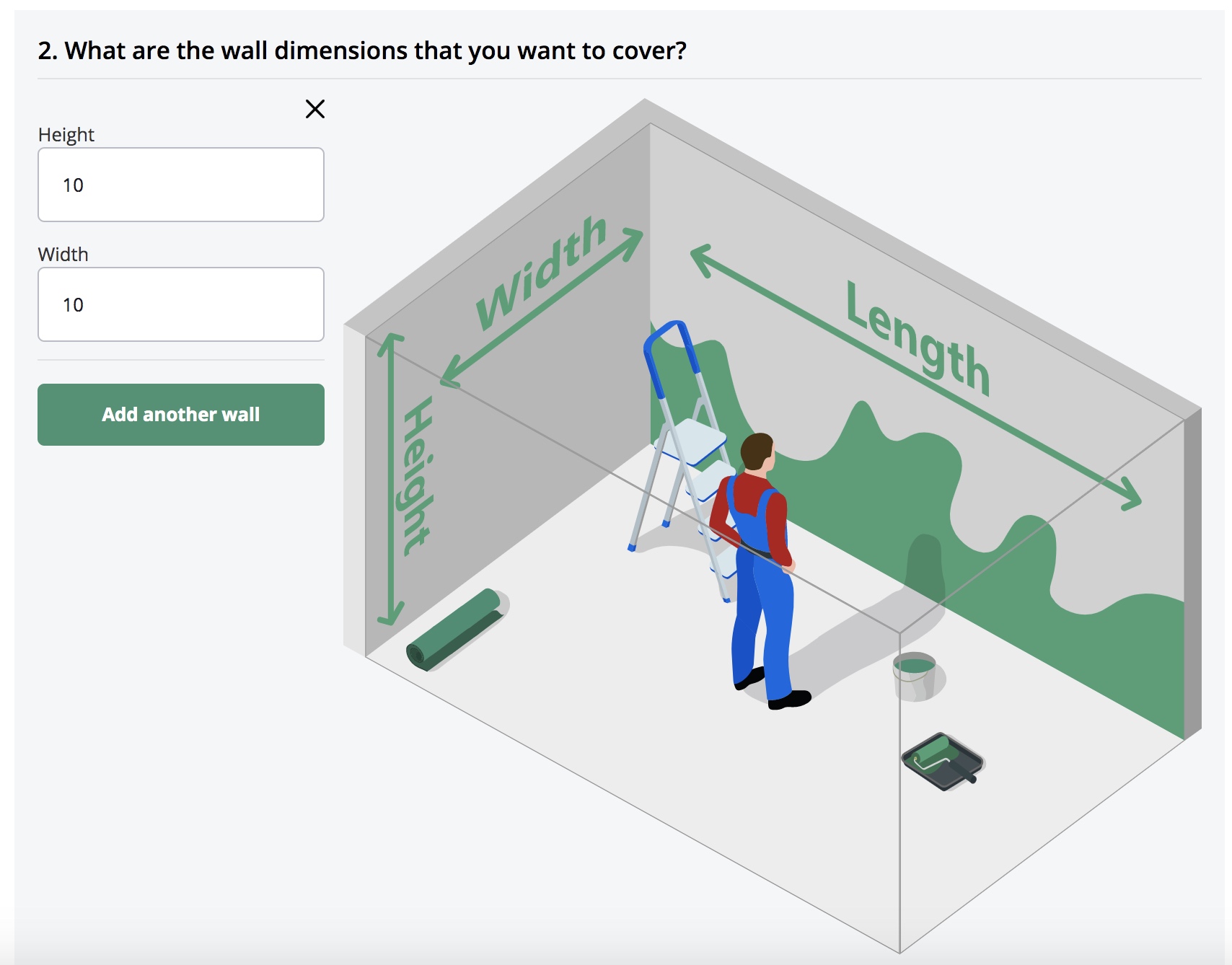
Online paint calculators are fantastic tools, but they’re only as good as the information you feed them. If you input only room length and width, they might assume standard ceiling heights and ignore doors/windows, leading to inaccuracies. Understand what each input field means and measure carefully before relying on them.
Quick Reference: Estimated Paint Needs for Common Room Sizes
While a precise calculation is always best, here’s a general guide for typical room sizes, assuming average wall height (2.5m / 8ft), two coats of paint, and a 10% waste factor. This table focuses on wall paint only.
How Much Paint for a Small Room (e.g., Bathroom, Small Office)
Think 2m x 3m (7ft x 10ft) to 2.5m x 3.5m (8ft x 11ft).
How Much Paint for a Medium Room (e.g., Bedroom, Dining Room)
Think 3m x 4m (10ft x 13ft) to 4m x 5m (13ft x 16ft).
How Much Paint for a Large Room (e.g., Living Room, Open-Concept Area)
Think 5m x 6m (16ft x 20ft) and larger.
| Room Size Category | Approximate Dimensions (Metric) | Approximate Dimensions (Imperial) | Estimated Wall Paint Needed (Liters) | Estimated Wall Paint Needed (Gallons) |
|---|---|---|---|---|
| Small Room | 2m x 3m (6m² floor) | 7ft x 10ft (70 sq ft floor) | 5-7 Liters | 1.3-1.8 Gallons |
| Medium Room | 3m x 4m (12m² floor) | 10ft x 13ft (130 sq ft floor) | 7-9 Liters | 1.8-2.4 Gallons |
| Large Room | 4m x 5m (20m² floor) | 13ft x 16ft (208 sq ft floor) | 9-12 Liters | 2.4-3.2 Gallons |
| Extra Large Room/Open Concept | 5m x 6m (30m² floor) | 16ft x 20ft (320 sq ft floor) | 12-16 Liters | 3.2-4.2 Gallons |
Final Thoughts: Confidence in Every Can
Calculating how many liters of paint for a room doesn’t have to be a daunting task. By taking a few careful measurements, understanding paint coverage, and applying a little bit of math, you can arrive at a surprisingly accurate estimate. This not only saves you money but also reduces stress and ensures your painting project flows smoothly from start to finish. Now go forth, measure with confidence, and transform your space!